
Blockchain Architecture
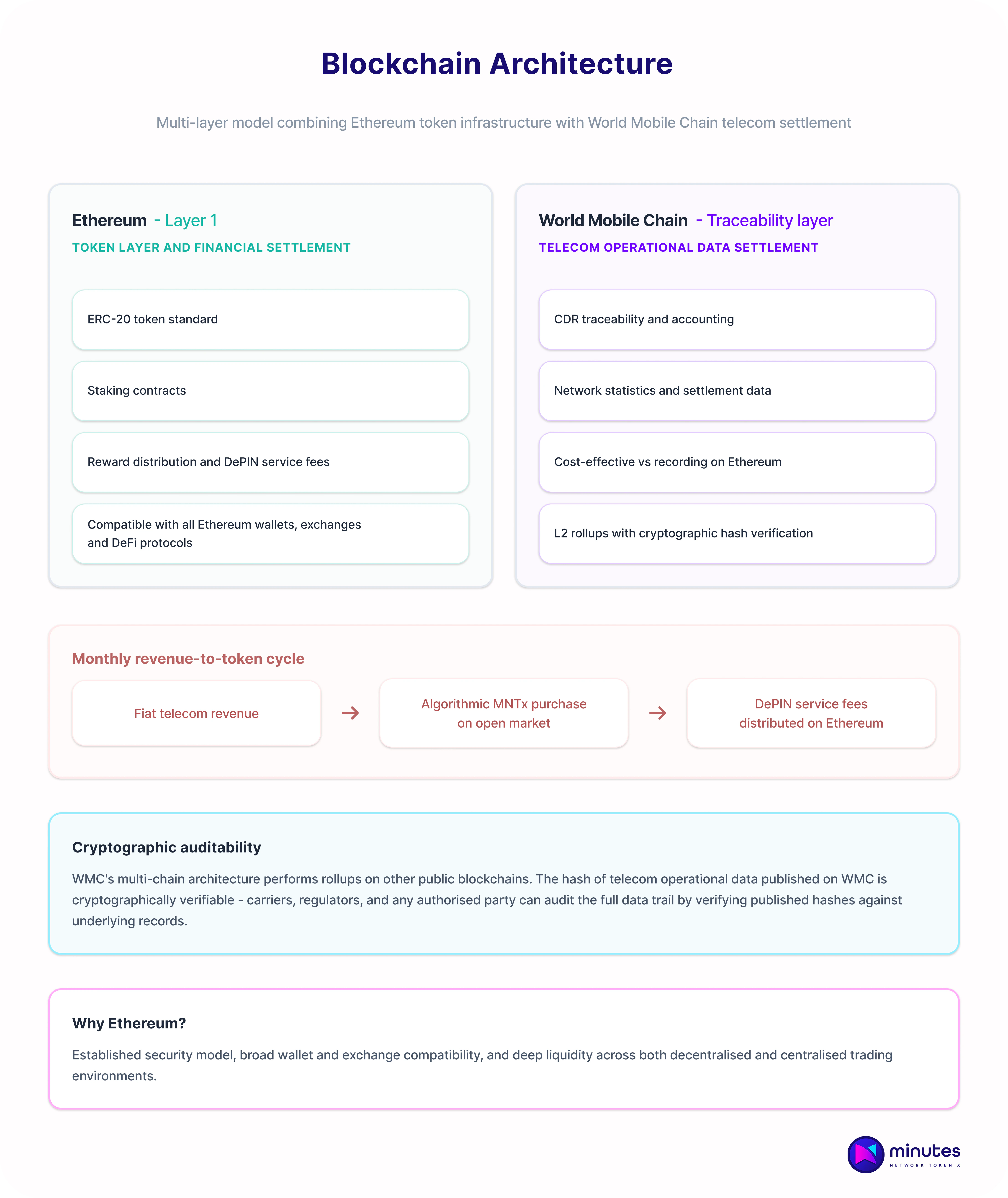
MNTx is deployed on Ethereum as an ERC-20 token. Ethereum serves as the Layer 1 settlement layer, handling core token functions such as transfers, staking contracts, and reward distribution (DePIN Service Fees). These rewards originate from an algorithmic purchase mechanism executed by Minutes Network, which converts fiat revenue into MNTx each month for distribution as DePIN Service Fees.
Ethereum was chosen for its established security model, broad wallet and exchange compatibility, and deep liquidity across decentralised and centralised trading environments. As an ERC-20 token, MNTx is compatible with any Ethereum-supporting wallet, exchange, or DeFi protocol without requiring custom integrations.
Beyond Ethereum, the architecture uses World Mobile Chain (WMC) as a traceability layer. WMC handles cost-effective data settlement for telecom-specific records, including CDR (Call Detail Record) traceability, network statistics, and accounting data. Recording this volume of operational data directly on Ethereum would be prohibitively expensive. WMC provides a purpose-built environment where telecom settlement data can be processed and stored at a fraction of the cost.
WMC's multichain architecture performs rollups on other public blockchains, with the hash of the data published on WMC serving as an additional trust layer. This means telecom operational records are not only stored but cryptographically verifiable. Carriers, regulators, or any authorised party can audit the data trail by verifying the published hashes against the underlying records.
This multi-layer model combines Ethereum's token security and liquidity with WMC's efficient telecom settlement framework. The token layer lives on Ethereum. The operational data layer lives on WMC. Together they provide both the financial infrastructure for MNTx and the transparent, auditable data layer that a carrier-grade telecom network requires.