
Market Opportunity
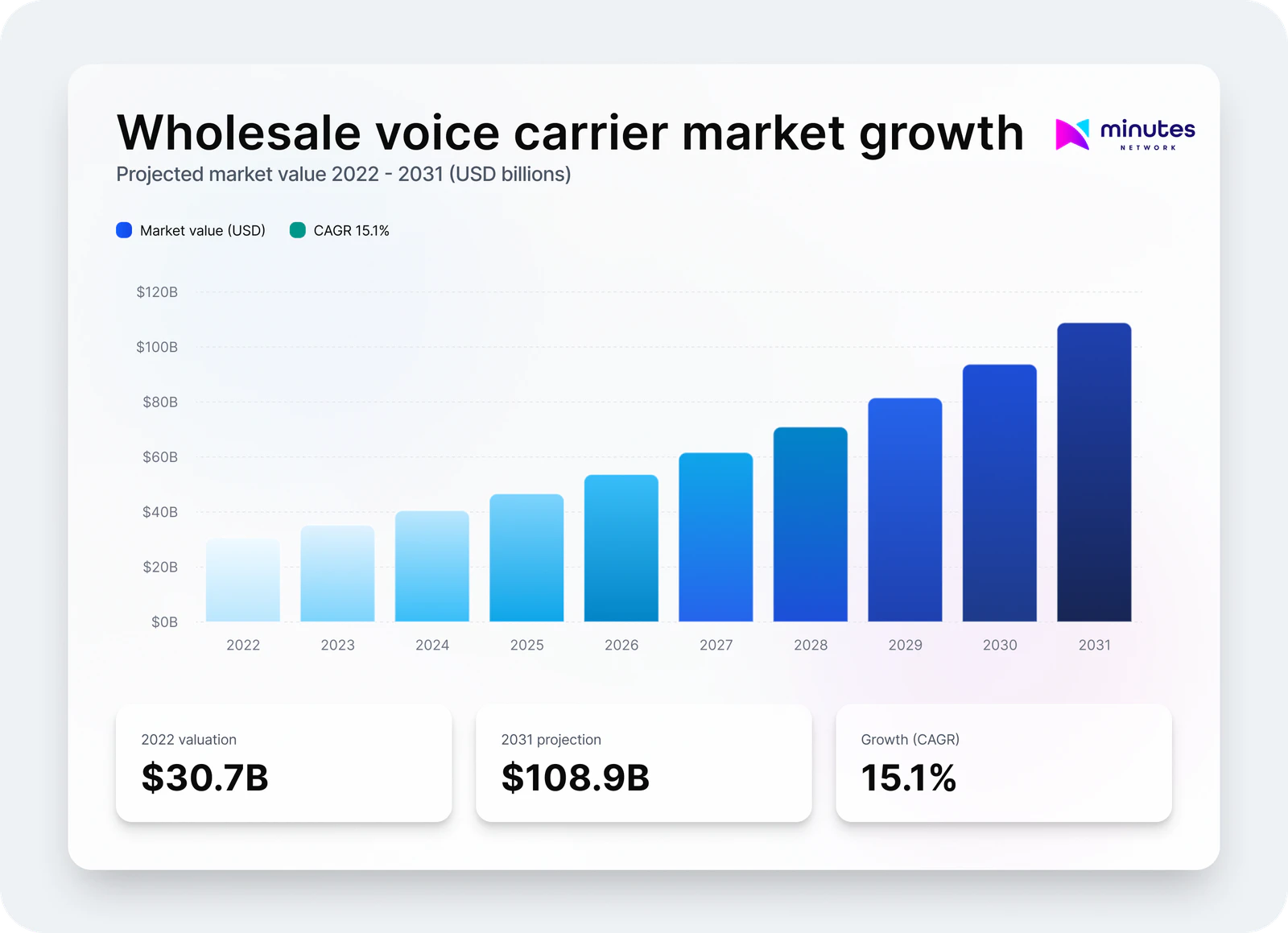
Minutes Network operates within the global paid-for voice calling market, which was projected to reach $251 billion in 2024. While the overall market shows a slight annual decline (CAGR of -2.74% through 2028), the wholesale voice carrier segment within it tells a different story. This subsegment was valued at $30.7 billion in 2022 and is projected to grow to $108.85 billion by 2031, driven by a CAGR of 15.1% as telecom providers increasingly shift from traditional data and voice services toward wholesale voice carrier services.
This is a significant commercial category, not a narrow niche. Over one-third of the market is held by major international telecommunications operators such as AT&T, Verizon, T-Mobile, and Vodafone, while the remaining 60%+ is fragmented across smaller regional and national carriers worldwide. Wholesale carriers already account for over 87% of terminated traffic volume in South America, 86% within Sub-Saharan Africa, and more than 56% of all voice call traffic to Western Europe.
The rise of VoIP and OTT platforms like WhatsApp, Viber, and Zoom has reshaped the industry by enabling free intra-application calls over data networks, bypassing traditional Public Switched Telephone Networks entirely. However, these platforms only serve calls between their own users. The moment a call needs to reach a standard phone number, whether local or international, it must pass through the wholesale termination system. This is the segment that remains resilient, large-scale, and commercially active.
The opportunity for Minutes Network lies not in the size of the market alone, but in its structural inefficiency. The wholesale voice termination supply chain involves multiple intermediaries, each adding cost. Carriers use Least Cost Routing systems to automatically rank available wholesale providers in ascending price order, always attempting the cheapest route first. This creates a commodity environment where the lowest-cost provider with acceptable quality wins the traffic.
Minutes Network's Mintech Revenue Turbine is specifically engineered to exploit this dynamic. By eliminating legacy infrastructure costs and operating a borderless, decentralised, IP-based model, the network is designed to always sit at the top of every carrier's LCR table as the lowest price option. Where traditional operators are constrained by physical infrastructure, regional licensing, and layered supply chains, Minutes Network extracts greater value from each connected call while still undercutting every competitor on price. This structural cost advantage is what makes the commercial model viable and the tokenised reward system sustainable.