
Validation Nodes
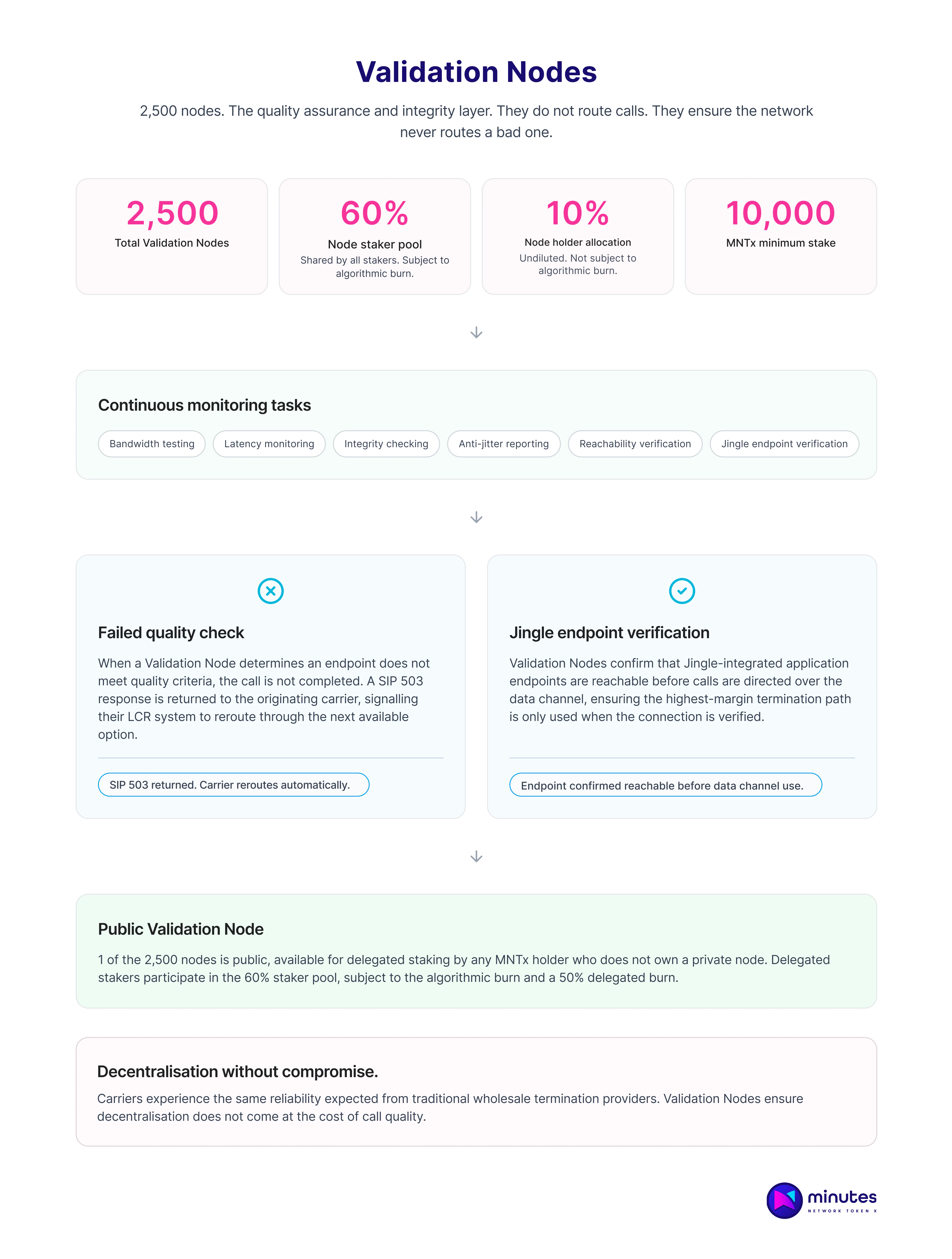
The Minutes Network contains 2,500 Validation Nodes: 2,499 privately held and one public node available for delegated staking.
Their role is to monitor network health, preserve operational integrity, and ensure that traffic quality meets carrier service expectations. They do not route or terminate calls. They provide the oversight and quality assurance layer that allows the network to maintain carrier-grade standards across a decentralised infrastructure.
Validation Nodes perform a continuous cycle of checks across the network, including bandwidth testing, latency monitoring, integrity checking, anti-jitter reporting, and reachability verification. Like Switch Nodes, they are randomly selected in real time for each validation task.
When a Validation Node determines that a destination endpoint does not meet quality criteria, the call is not completed. Instead, the network returns a SIP 503 response to the originating carrier, signalling their LCR system to reroute the call through the next available option. This mechanism ensures that decentralisation does not come at the cost of call quality. Carriers experience the same reliability they expect from any traditional wholesale termination provider.
Validation Nodes also play a role in verifying the availability of application users integrated via the Jingle Plug-In, confirming that endpoints are reachable before calls are directed over the data channel.
Validation Node operators receive their share from the 10% node operator allocation, the same undiluted pool as Switch Node operators. Stakers who delegate MNTx to Validation Nodes participate in the 60% staker pool, which is subject to the algorithmic burn calculation.
Minimum staking threshold: 10,000 MNTx.
These nodes perform monitoring, integrity checking, and quality assurance tasks, which can run on virtualised environments with more modest specifications.
Validation Node Requirements
Processor: 2.4 GHz Intel or AMD
RAM: 8 GB
Storage: 240 GB SSD
Network: 100 MB NIC
OS Kernel: Modern Linux
Hosting: Virtualised or dedicated
The key distinction is that Switch Nodes require dedicated hardware, while Validation Nodes can operate on virtualised environments such as cloud-hosted virtual machines. Both node types require SSD storage and a modern Linux operating system.
These are minimum specifications. Operators running nodes in high-traffic environments or across multiple destinations may benefit from exceeding these requirements to ensure consistent performance and uptime.