Buy-Back and Distribution
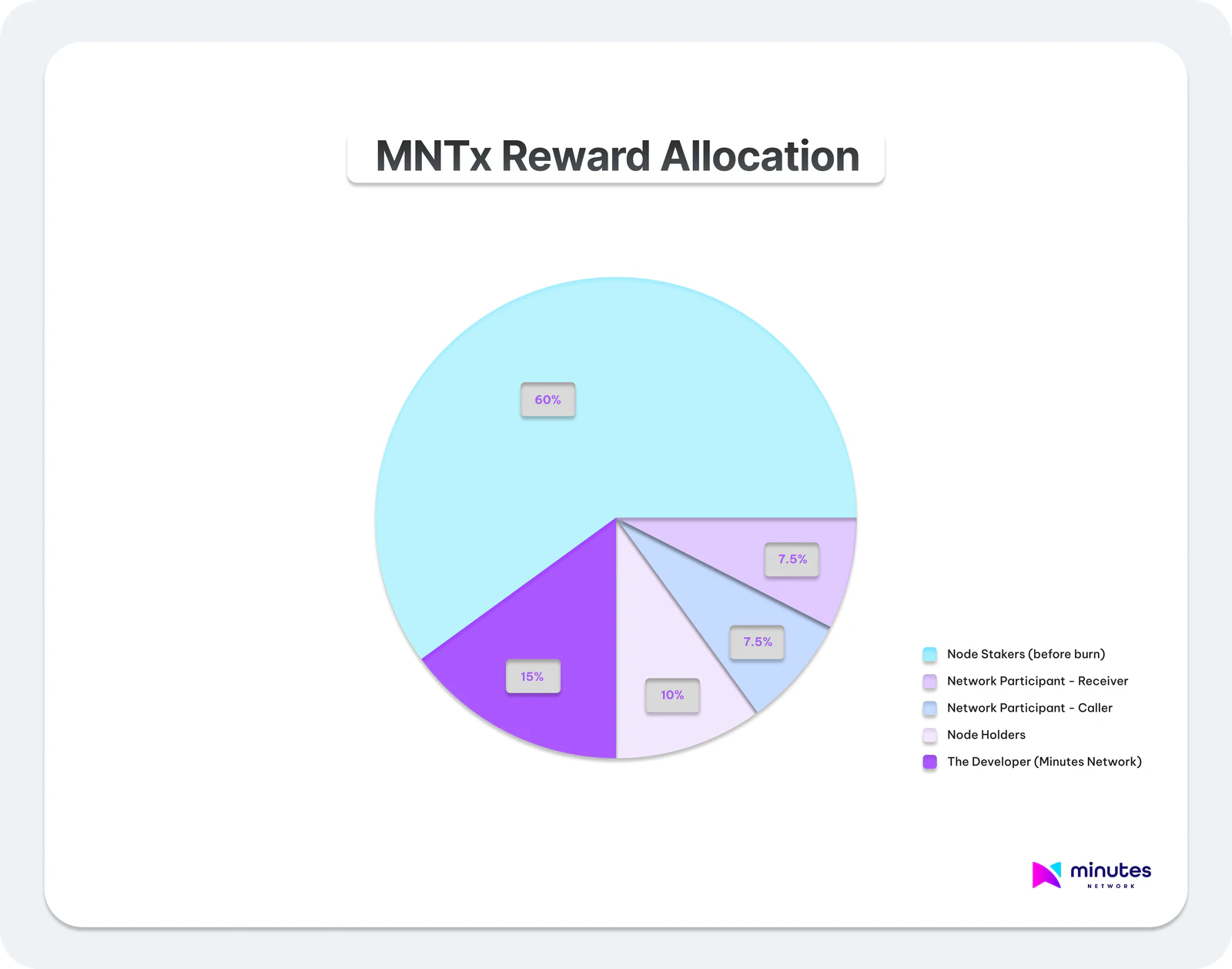
The economic flow that drives the MNTx reward cycle follows a defined sequence. Telecom operations generate fiat revenue. That revenue is used to purchase MNTx on the open market for the DePIN Service Fees. The purchased tokens enter the reward cycle, where they are split across the four allocation pools. Algorithmic burns are applied where relevant. The remaining balances are distributed to participants.
This sequence repeats every epoch without manual intervention. The purchases are algorithmic, the splits are fixed, and the burns are formula-driven. No discretionary decisions determine how much is bought, how it is divided, or how much is burned. The process is governed by smart contracts and executes automatically based on market conditions, revenue etc for an optimized result for the node holders and stakers longerm.
This structure is a central reason the ecosystem is positioned as a real-economy token model rather than a purely self-referential crypto system. Demand for MNTx in each epoch does not originate from new investors purchasing tokens on secondary markets, nor from inflationary emissions designed to simulate yield. Instead, it is driven by a live telecommunications business that purchases tokens using revenue generated from terminating real international voice calls, which are then distributed as DePIN Service Fees within the node economy. As a result, the token's role in the reward cycle is underpinned by operational activity rather than speculation.