
Hybrid DePIN Architecture
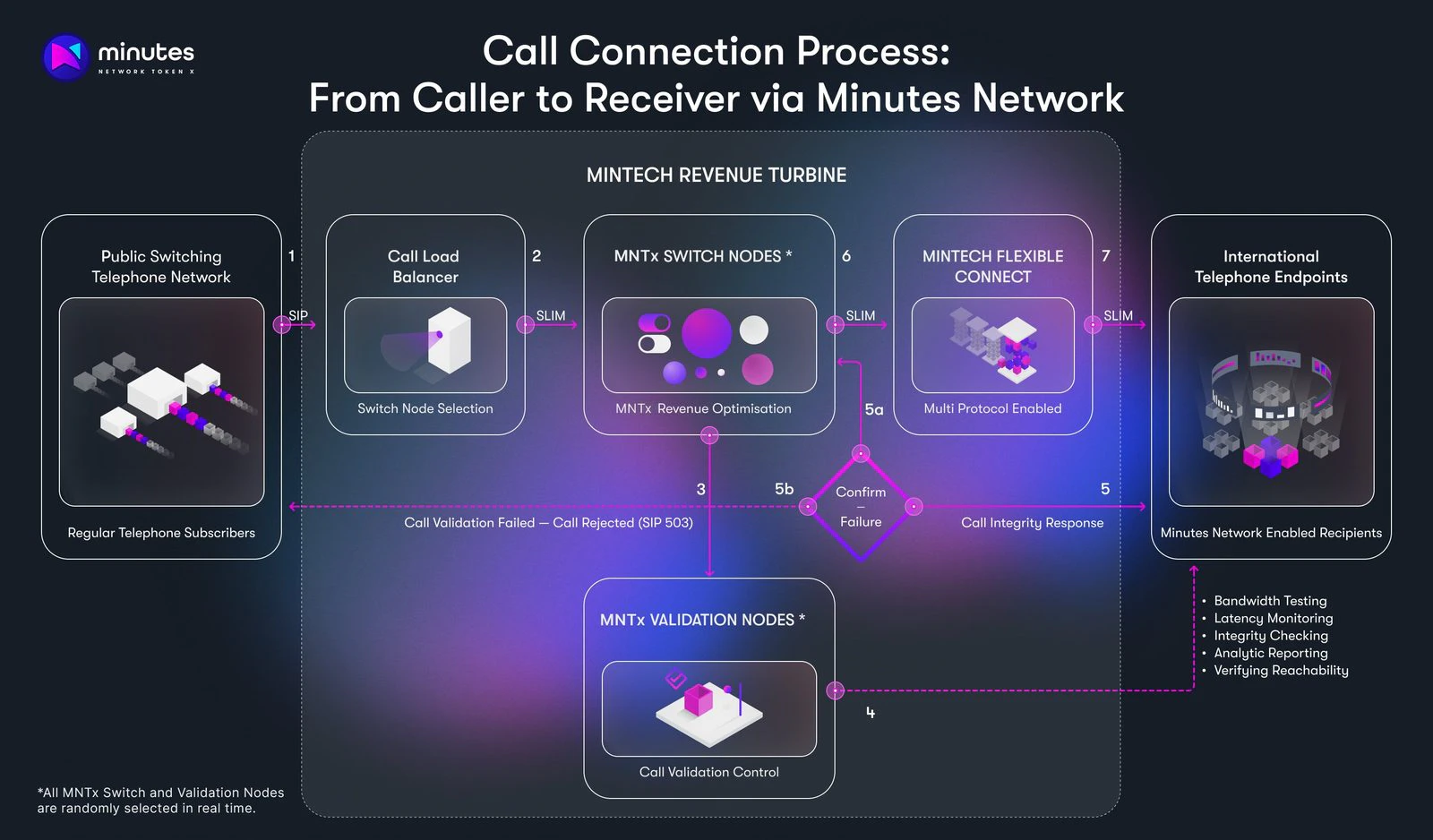
Minutes Network is designed as a hybrid DePIN model for paid-for voice telecommunications. It does not replace traditional telecom systems outright. Instead, it integrates legacy telecom routing and carrier interconnections with decentralised node infrastructure, blockchain-based settlement logic, and token-driven incentive mechanics into a single operating architecture.
This hybrid approach is what makes the model commercially viable. The network must interoperate with the existing global telecom system to receive and terminate voice traffic from international carriers. At the same time, it introduces a fundamentally different economic and operational framework around how that traffic is processed, how the infrastructure is operated, and how the resulting value is distributed.
The Legacy Layer
On the carrier-facing side, Minutes Network operates within the established conventions of the wholesale voice termination industry. It connects to originating carriers using the global-standard Session Initiation Protocol (SIP), the same protocol used by every traditional wholesale provider. Carriers onboard Minutes Network into their Least Cost Routing tables alongside their existing portfolio of wholesale interconnections. From the carrier's perspective, the integration is operationally identical to working with any other wholesale termination provider.
This compatibility is essential. Carriers do not need to adopt new protocols, modify their infrastructure, or understand the underlying blockchain mechanics to send traffic to Minutes Network. They simply add the network as an interconnection, and their LCR system handles the rest based on price and quality.
The Decentralised Layer
Behind the carrier-facing interface, the network operates on a decentralised DePIN architecture. Voice traffic is routed and processed through 500 Switch Nodes and monitored by 2,500 Validation Nodes, all secured through MNTx staking by distributed infrastructure operators rather than a single centralised entity.
The Mintech Operating System deploys three protocols to manage call switching:
· SIP for carrier interconnection
· Proprietary closed-source protocol for connecting to termination endpoints,
· Proprietary open-source protocol for internode communication.
This layered protocol architecture allows the network to function as the sole telephone call switching interface between the originating carrier and the call recipient, while maintaining the decentralised distribution of processing across the node network.
Validation Nodes continuously perform bandwidth testing, latency monitoring, integrity checking, anti-jitter reporting, and reachability verification across the network. Calls directed to endpoints that do not meet quality criteria are redirected back to the carrier with a SIP 503 response, signalling the call to be rerouted through the carrier's next available LCR option. This ensures that decentralisation does not come at the cost of call quality.
The Blockchain Layer
Settlement, reward distribution, and infrastructure ownership are managed on-chain. MNTx is deployed as an ERC-20 token on Ethereum, which serves as the Layer-1 settlement layer. World Mobile Chain provides a traceability layer for cost-effective data settlement, including CDR traceability, statistics, and accounting. WMC's multichain architecture performs rollups on other public blockchains, with the hash of the data published on WMC serving as an additional trust layer.
All net revenue from telecom operations is algorithmically converted into MNTx token purchases through each month for DePIN Service fees. The reward distribution, the algorithmic burn, and the staking mechanics are all executed via smart contracts with no manual intervention. Node ownership is represented as NFTs on-chain, and every phone number that appears on the network is assigned a non-custodial wallet for reward collection.
The Application Layer
The Jingle Plug-In extends the network's reach beyond traditional PSTN termination. When a call recipient is on an application that has integrated the Jingle Plug-In, the call is terminated directly over the data network, bypassing PSTN infrastructure entirely. This eliminates traditional termination fees, allows the network to retain nearly 100% of call revenue, and delivers HD call quality with guaranteed CLI delivery.
This layer is what enables the network to scale its user base without consumer marketing or subscriptions. Applications integrate the lightweight SDK, their entire user base becomes reachable on the network, and the application receives a new incremental revenue stream from the voice traffic terminated over its platform.
Why Hybrid
The hybrid architecture exists because neither a purely traditional model nor a purely decentralised model would work in this industry. A traditional wholesale carrier cannot offer the cost structure that decentralised infrastructure provides. A purely decentralised network cannot interoperate with the global carrier ecosystem without SIP compatibility, quality monitoring, and commercial-grade routing.
By combining both, Minutes Network achieves something that neither approach can deliver alone: the lowest termination rates in the market (driven by the elimination of legacy infrastructure costs), carrier-grade quality and interoperability (driven by SIP compliance and Validation Node monitoring), decentralised resilience and scalability (driven by the distributed node architecture), and a token-based sharing economy that redistributes value to every participant in the system.
The network is therefore positioned as decentralised, borderless, digital, blockchain-enabled, and infrastructure-backed, while remaining fully anchored in real telecom operations and commercially interoperable with the existing global carrier ecosystem.