
Least Cost Routing
Least Cost Routing is the industry-standard process by which voice carriers determine how to route their call traffic across available wholesale paths. It is the mechanism that governs which wholesale provider terminates a given call, and it sits at the centre of how the international voice termination market operates commercially.
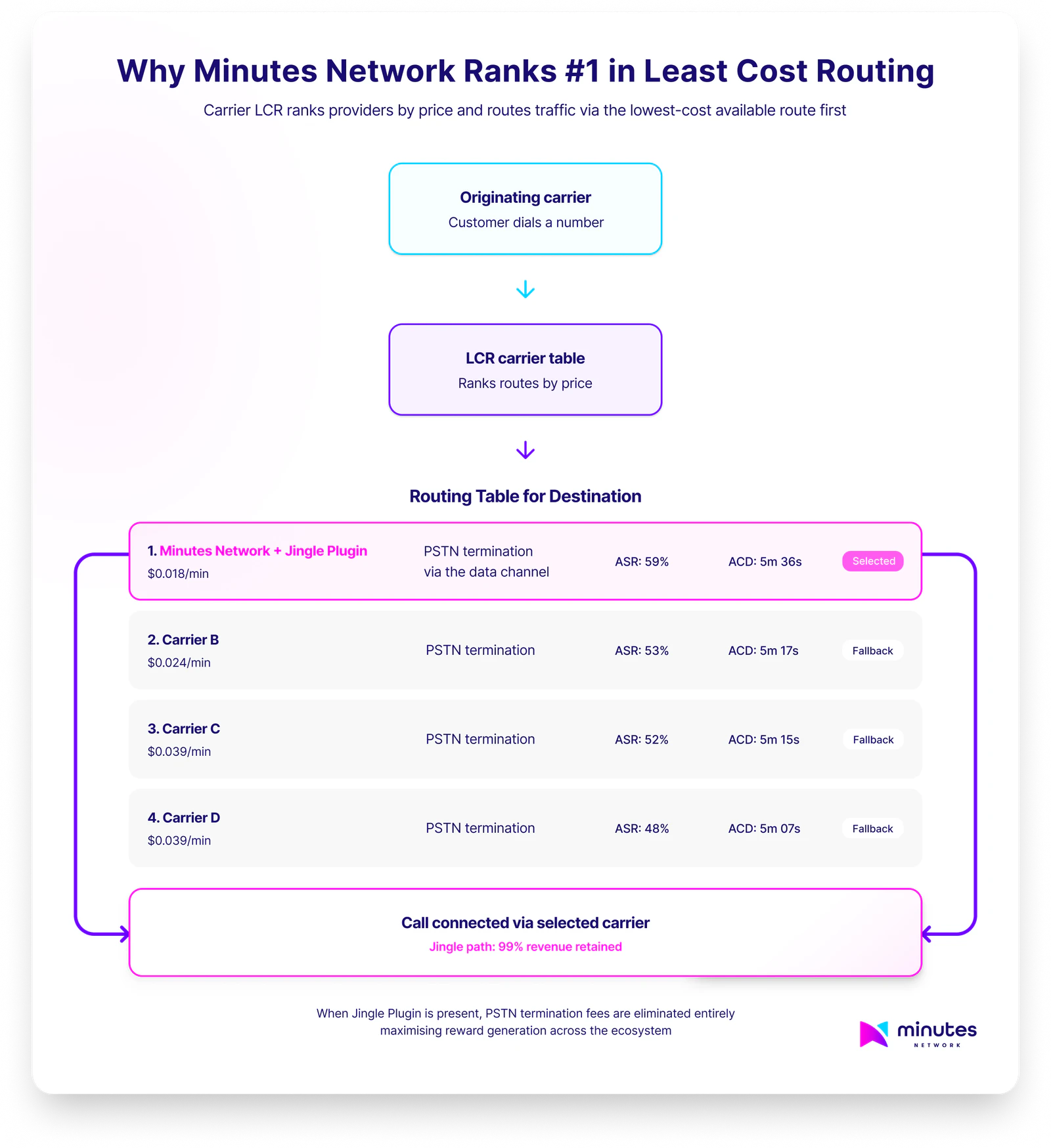
When a carrier needs to connect an international or out-of-network call, it does not rely on a single wholesale provider. Instead, it maintains a portfolio of wholesale interconnections, each offering different routes, rates, and quality levels depending on their regional position and cost structure. LCR systems automatically rank these available routes in ascending cost order and attempt to connect each call via the cheapest viable option. If the first route fails or is unavailable, the system seamlessly tries the next route in the ranking until a suitable connection is established.
The ranking is determined by two primary criteria: cost and acceptable quality. Quality thresholds are set by the originating carrier based on metrics such as Answer Seizure Ratio (ASR), Average Call Duration (ACD), Post Dial Delay (PDD), and Calling Line Identification (CLI) delivery. A route must meet minimum quality standards to remain in the LCR table, but among qualifying routes, the cheapest option wins.
This makes wholesale voice termination a pure commodity environment. The provider ranked lowest on price, while still meeting quality requirements, receives first opportunity to carry the traffic. Every position on the LCR table matters: being ranked first means receiving traffic before any competitor, while being ranked second means only receiving traffic when the first-choice provider is unavailable or at capacity. There is no brand loyalty, no long-term lock-in, and no negotiation on a per-call basis. The LCR system operates automatically, in real time, across every call attempt.
Why LCR Matters for the Ecosystem
The LCR mechanism is what makes Minutes Network's commercial model viable. In a market where the lowest-cost provider wins the traffic, the ability to consistently undercut competitors on price while maintaining acceptable quality is the single most important competitive advantage a wholesale operator can hold.
Every carrier with whom Minutes Network is interconnected runs an LCR system. If Minutes Network's rates are the lowest on that carrier's table for a given destination (which is guaranteed by design), it receives first-choice traffic for that route. The more carriers that rank Minutes Network at the top of their LCR tables, the more voice traffic flows through the network, the more revenue is generated, and the more MNTx can be algorithmically purchased and distributed as rewards.
Minutes Network's Structural Advantage
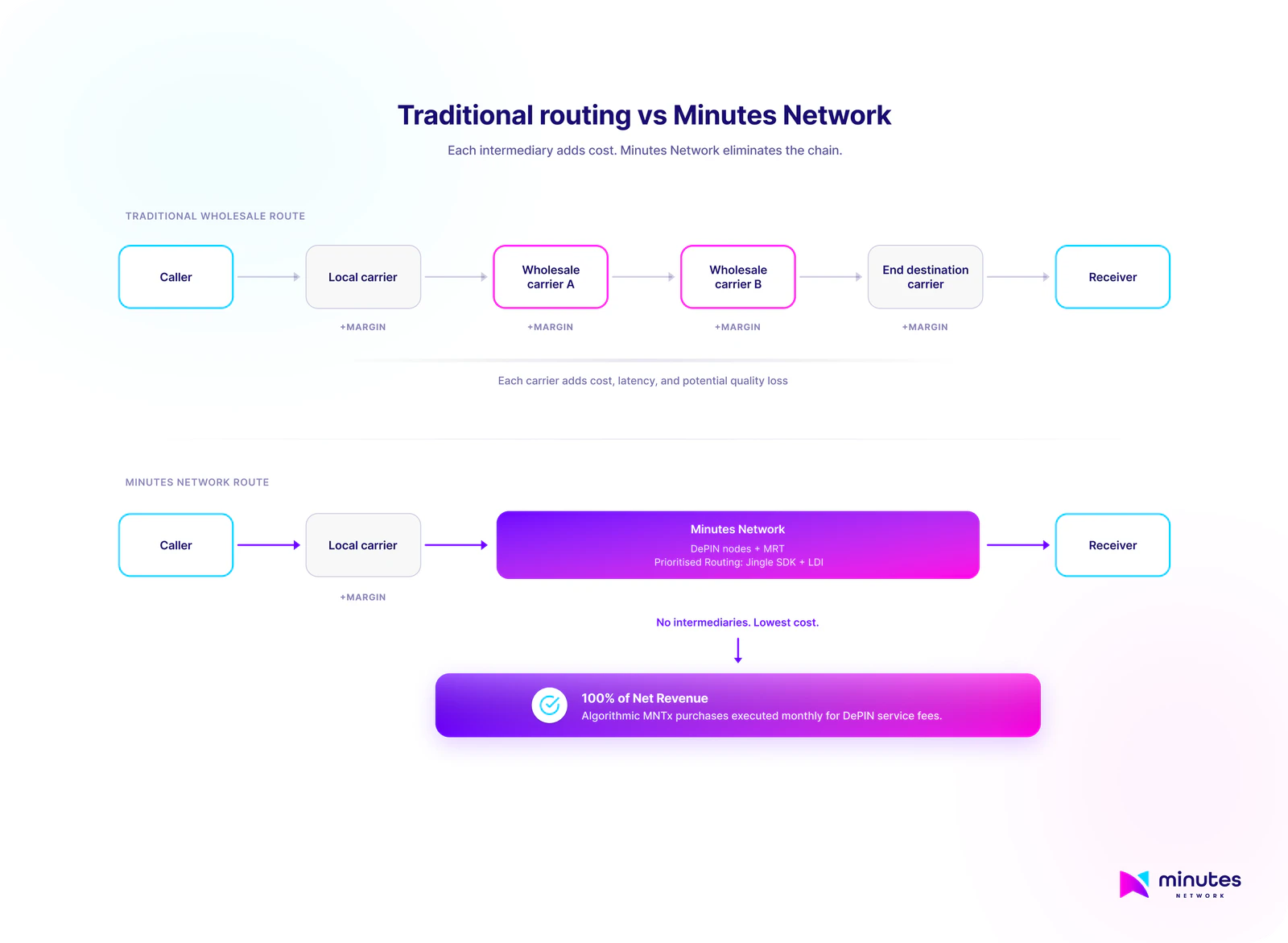
Minutes Network's architecture is specifically engineered to hold the top position on carrier LCR tables. The Mintech Revenue Turbine (MRT) optimises the cost and profitability of every call the network handles, allowing it to offer carriers the lowest termination rates in the market while extracting maximum value from each connected call.
Where traditional wholesale operators carry legacy infrastructure costs, regional licensing overhead, physical points of presence, and layered intermediary charges, Minutes Network operates a borderless, decentralised, digital IP-based model with a close-to-zero cost termination structure. This is not a marginal improvement. The structural elimination of legacy costs means the network can price below any carrier that still operates within the traditional supply chain model.
The result is a guarantee to interconnecting carriers: Minutes Network will always be their lowest-cost service provider. In LCR terms, this means first-choice positioning, maximum traffic capture, and a direct link between the network's commercial performance and the scale of MNTx rewards flowing through the ecosystem.