User Growth Model
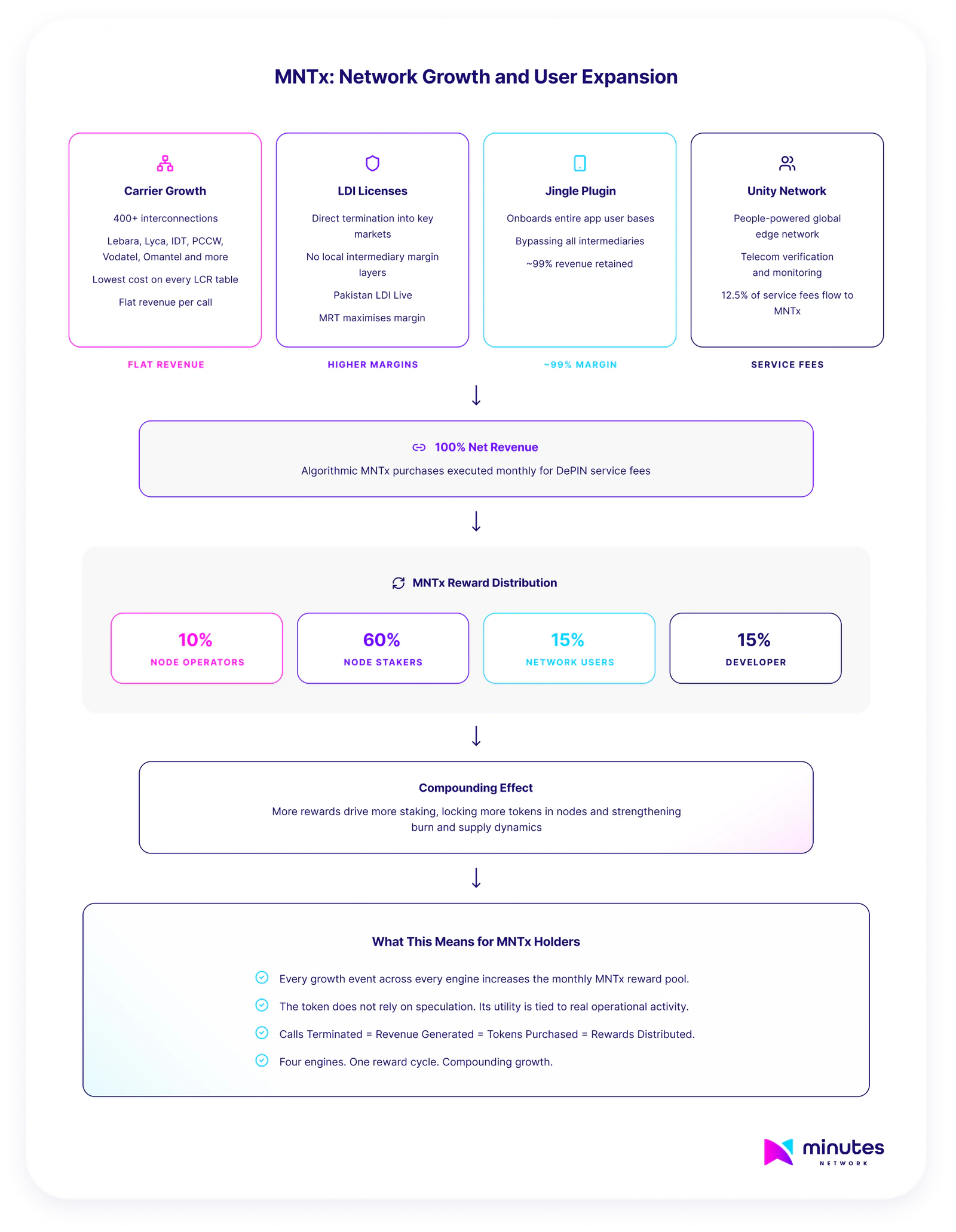
Minutes Network Token X sits at the centre of an ecosystem where multiple independent growth engines each contribute to the same outcome: increasing the volume of MNTx flowing through the reward cycle. Each engine operates differently, serves a different market, and scales through its own mechanisms, but all of them generate activity that feeds back into the MNTx token economy.
Carrier Growth
The first engine is carrier-driven. Minutes Network onboards wholesale voice carriers who send international call traffic through the network because it offers the lowest termination rates in the market. Over 400 carrier interconnections have been secured, including relationships with Skype, Lebara, Lyca Mobile, IDT, PCCW, Vodatel, Omantel, WorldCall, Next Communications, Sygmatel, and Digitalk. Through these partnerships, the network receives traffic from major Tier 1 operators such as Telefonica and Telecom Italia.
Every call terminated generates fiat revenue. 100% of the net revenue is used to algorithmically purchase MNTx as payment for DePIN service fees. Those tokens are then distributed as rewards to node operators, stakers, network users, and the developer. The more carriers that are interconnected, the more traffic flows through the network, and the larger the monthly MNTx purchases become.
Jingle Plug-In Growth
The second engine is application-driven. The Jingle Plug-In integrates directly with mobile applications, onboarding entire user bases as reachable endpoints on the Minutes Network. A single integration can bring hundreds of millions of users onto the network in a single deployment event, with no consumer marketing, no subscriptions, and no action required from the end user.
When a call is terminated to a recipient on a Jingle-integrated application, the call bypasses the PSTN entirely and is delivered over the data channel. This eliminates traditional termination fees, allowing Minutes Network to retain nearly 100% of call revenue on those connections. The revenue economics improve with every Jingle user added to the network. More Jingle endpoints mean more calls bypass the PSTN, more revenue is captured per call, and more MNTx is purchased and distributed each month.
From the MNTx perspective, Jingle is the most powerful revenue multiplier in the ecosystem. It does not just increase traffic volume. It fundamentally changes the margin on every call, meaning the same number of minutes generates significantly more MNTx rewards when Jingle is present.
Unity Network Growth
The third engine operates independently through Unity Network. Unity is a people-powered global edge network where smartphone users perform Proof-of-Work tasks related to telecom verification, monitoring, and network intelligence. Unity generates its own service fees from carriers and enterprises.
25% of all Unity network service fees are pooled and transferred to the MNTx and WMTx reward pools. This is not drawn from existing MNTx staking rewards. It is additive revenue, a new income stream feeding into the same token economy from an entirely separate operational layer. As Unity scales its participant base and expands its carrier and enterprise client relationships, the volume of fees flowing into MNTx grows independently of call termination activity.
From the MNTx perspective, Unity provides diversification. The token economy is no longer dependent on a single revenue source. Voice termination, Jingle-based direct termination, and Unity network service fees each contribute to the monthly MNTx purchases, making the reward cycle more resilient and scalable.
The Compounding Effect for MNTx
All three engines feed the same cycle. Carriers send voice traffic. Jingle improves the revenue captured per call. Unity adds an independent service fee stream. All revenue is converted into MNTx purchases for DePIN Service fees payment. The collect DePIN service fees are distributed as rewards to node operators (10%), node stakers (60%), network users (15%), and the developer (15%).
As the volume of MNTx being purchased each month increases, the demand side of the token economy strengthens. As rewards grow, staking becomes more attractive, which increases the proportion of tokens locked in nodes, which in turn affects the algorithmic burn calculation and the circulating supply dynamics.
Each engine reinforces the others. More carrier traffic creates demand for Jingle endpoints. More Jingle users make the network more attractive to carriers. More Unity participants generate additional fees that flow into MNTx. The result is a compounding growth model where MNTx benefits from every expansion event across every layer of the ecosystem, regardless of which engine drives it.
What This Means for MNTx Holders
For anyone holding or staking MNTx, the growth of each engine translates directly into the scale of the reward pool. The token does not rely on speculation or secondary market activity for its utility. Its value within the ecosystem is tied to real operational activity: calls terminated, revenue generated, tokens purchased, and rewards distributed. The more the network grows across all three engines, the more MNTx circulates through the reward cycle each month.