
Wholesale Voice Termination
Wholesale voice termination is the process through which carriers route and complete calls across networks where they do not hold direct endpoint access. When a caller dials an international or out-of-network number, the originating carrier must hand that traffic to a wholesale termination provider who can connect the call to the destination network. This handoff may pass through one or several intermediaries before the call reaches the recipient.
This service underpins both international and domestic connectivity across the global telecommunications system. It is the mechanism that allows a subscriber on one network in one country to reach a subscriber on an entirely different network in another country, even when no direct relationship exists between the two carriers.
Wholesale termination is therefore a foundational layer of the telecom industry. It is where rates, interconnections, routing quality, and traffic economics converge. Every carrier operating in international voice must maintain a portfolio of wholesale interconnections, each offering different routes, rates, and quality levels depending on regional location and market position. Wholesale prices reflect the total supply chain cost structure, including the regulator-determined minimum termination cost in each end market.
To manage this complexity, carriers use Least Cost Routing (LCR) systems. These systems automatically rank available wholesale routes in ascending cost order and attempt to connect each call via the cheapest viable option, trying each route in sequence until a suitable connection is established. The provider sitting at the top of the LCR table, offering the lowest rate at acceptable quality, wins the traffic. This makes wholesale voice termination a pure commodity environment where cost efficiency is the primary competitive differentiator.
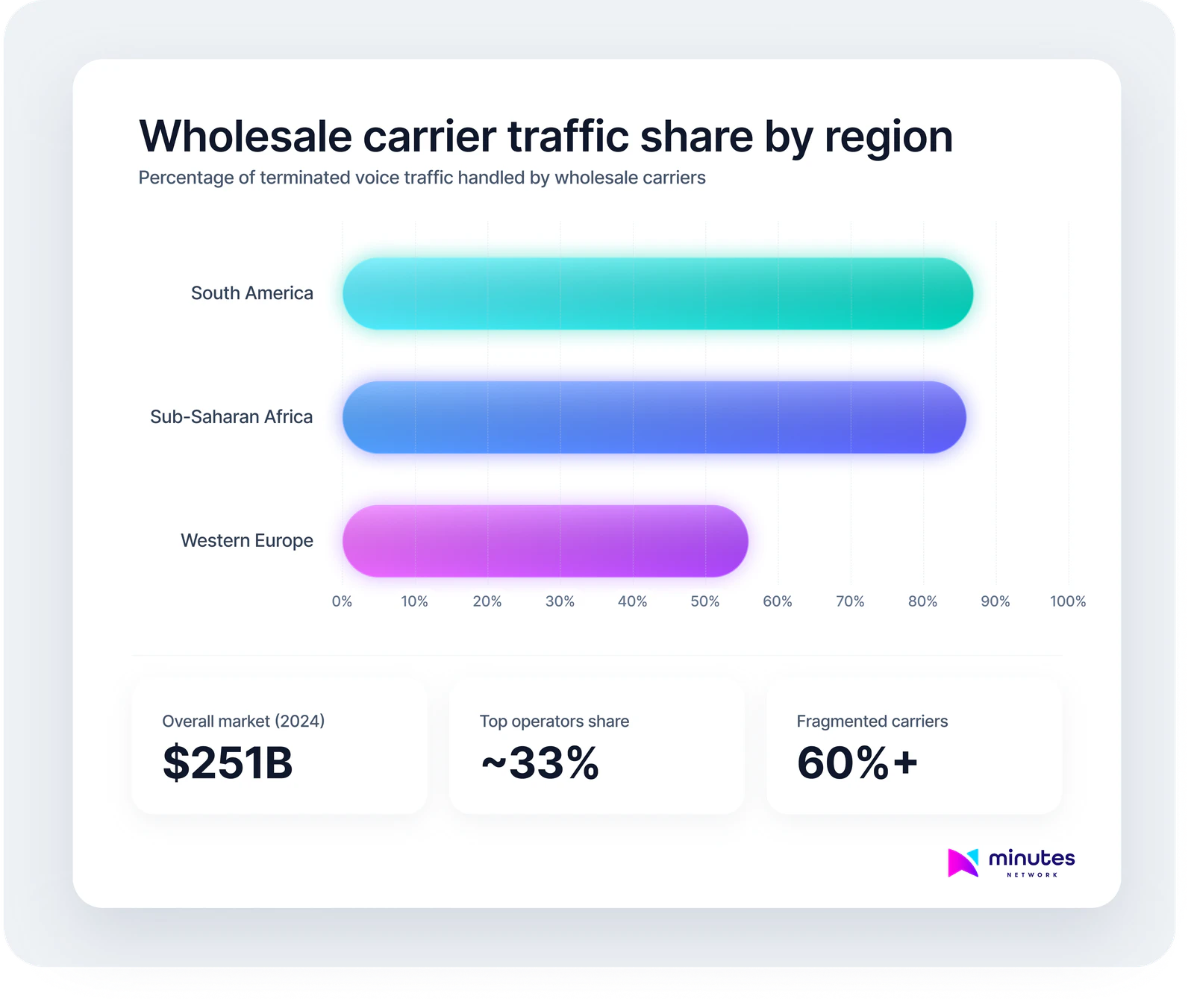
The market is highly fragmented. While major international operators like AT&T, Verizon, and Vodafone hold roughly one-third of global mobile voice revenues, over 60% of the market is distributed across thousands of smaller regional and national carriers. Wholesale carriers handle the vast majority of terminated traffic in many regions, exceeding 87% of total volume in South America, 86% in Sub-Saharan Africa, and over 56% of all voice call traffic to Western Europe.
Minutes Network's Position
Minutes Network participates in this layer as a wholesale voice-call termination service provider. Its competitive position is built on the Mintech Revenue Turbine (MRT), a proprietary system engineered to optimise costs and profitability on every call, allowing the network to offer carriers the lowest termination rates in the market while extracting the maximum value from each connected call.
Where traditional wholesale operators carry legacy infrastructure costs, regional licensing overhead, and layered intermediary charges, Minutes Network operates a borderless, decentralised, digital IP-based model with a close-to-zero cost termination structure. The MRT ensures that Minutes Network is always ranked as the lowest price option on every carrier's LCR table, giving it first opportunity to pass traffic for every carrier with whom it is interconnected. For carriers, this translates to a simple guarantee: Minutes Network will always be their lowest-cost service provider.
This structural advantage is what allows the network to win business in a global commodity market while simultaneously generating sufficient net revenue to sustain the MNTx token reward cycle that underpins the broader ecosystem.