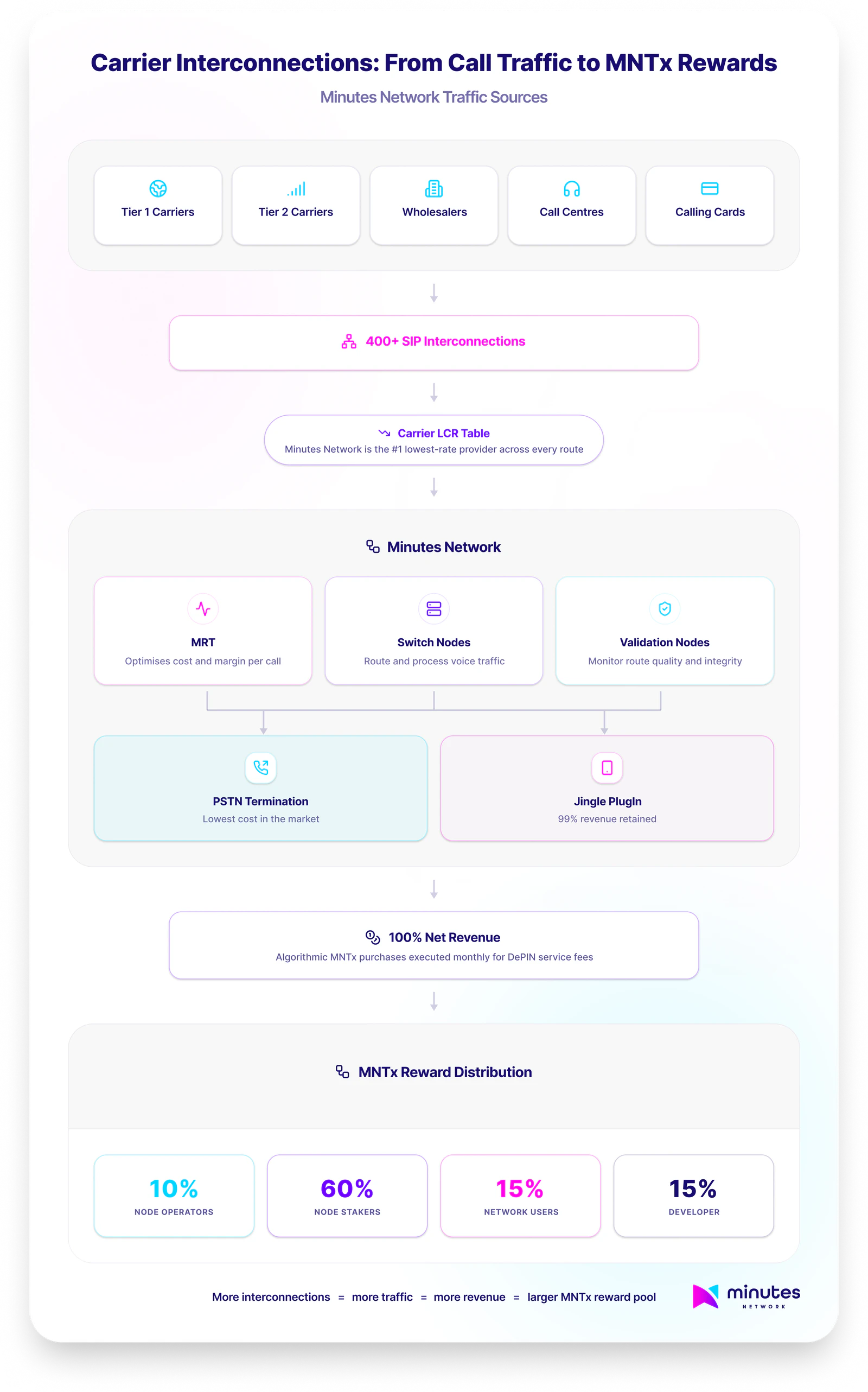

Carrier Interconnections
Carrier interconnection is the commercial and technical foundation on which Minutes Network's entire revenue model is built. Without interconnections, there is no inbound traffic. Without traffic, there is no revenue. Without revenue, there are no MNTx purchases and no rewards. Every other layer of the ecosystem depends on the network's ability to win and process voice traffic from international carriers.
An interconnection is a formal agreement between two carriers that enables them to exchange voice traffic. When Minutes Network establishes an interconnection with a carrier, it becomes a registered termination option within that carrier's routing environment. The carrier's Least Cost Routing (LCR) system then automatically includes Minutes Network's rates alongside every other wholesale provider when determining how to route each call.
Because the Mintech Revenue Turbine (MRT) ensures Minutes Network offers the lowest termination rates in the market for every route it serves, the network is designed to sit at the top of every carrier's LCR table. This means it receives first-choice traffic: the carrier's system attempts to route calls through Minutes Network before trying any competitor. The network only loses traffic on a given route if it is unavailable or at capacity.
How Interconnections Work
The technical side of each interconnection is handled through the Session Initiation Protocol (SIP), the global standard used by all voice carriers for setting up, managing, and terminating VoIP calls. From the carrier's perspective, onboarding Minutes Network is operationally identical to adding any other wholesale termination provider. There is no requirement to adopt new protocols, modify existing infrastructure, or understand the underlying blockchain mechanics. The carrier simply adds the SIP trunk, receives a rate sheet, and their LCR system handles the rest.
Once interconnected, the carrier begins sending call traffic to Minutes Network for any destination where the network's rate is the lowest available option. Minutes Network's Switch Nodes route the call, the Validation Nodes verify quality and integrity, and the call is terminated either through the PSTN (via the MRT at the lowest cost in the market) or directly over the data channel (via the Jingle Plug-In where the recipient is on an integrated application).
Each carrier interconnection does not represent a single traffic source. Major carriers maintain their own networks of partners, resellers, and aggregated traffic from MNOs, call centres, and calling card providers. A single interconnection with a Tier 1 or Tier 2 carrier can open access to traffic originating from dozens of underlying sources across multiple countries.
Current Interconnection Partners
Minutes Network has secured over 400 carrier interconnections worldwide. Named partners include Lebara, Lyca Mobile, IDT, PCCW, Vodatel, Omantel, WorldCall, Next Communications, Sygmatel, Digitalk, and Zain Telecom. Through these relationships, the network receives traffic from major Tier 1 operators.
The network's interconnection base is expanding actively. In a 60-day period alone, Minutes Network added more than 10 additional Tier 1 and Tier 2 carriers. The team regularly attends major industry events including Mobile World Congress, Wholesale World Congress (Madrid), and Capacity Europe (London) to establish new relationships and strengthen existing ones.
A-Z traffic (covering all international destinations) is now live across the network, with retail traffic volumes sourced from MNOs, call centres, and calling card providers and delivered to over 50 countries worldwide.
Why Carriers Choose Minutes Network
The value proposition for carriers is straightforward. Minutes Network is the #1 lowest-rate provider across every route. In a commodity market where price determines routing priority, this translates directly into first-choice positioning on every LCR table.
Beyond price, the network offers HD call quality through its hybrid DePIN architecture, guaranteed CLI delivery across all routes, zero grey-route activity (all connections are fully compliant and legitimate), and continuous quality monitoring through 2,500 Validation Nodes performing bandwidth testing, latency monitoring, integrity checking, and reachability verification in real time.
For carriers, there is no downside to adding Minutes Network as an interconnection. If it offers the best rate, they save money on termination. If it does not, their LCR system simply routes the call through the next cheapest option. The integration cost is negligible (a standard SIP trunk), and the potential savings on termination costs are immediate.
What Interconnections Mean for MNTx
Every interconnection is a potential source of recurring revenue. Each carrier that connects to the network brings with it a volume of international voice traffic that generates fiat revenue every time a call is terminated. 100% of that net revenue is used for algorithmic purchases of MNTx as payment for DePIN service fees each month.
The relationship between interconnections and MNTx rewards is direct. More interconnections mean more carriers routing traffic through the network. More traffic means more revenue. More revenue means larger monthly MNTx purchases. Larger purchases mean bigger reward distributions to node operators, stakers, network users, and the developer.
As the network continues to add carriers, acquire LDI licenses in key markets, and deploy the Jingle Plug-In to increase revenue capture per call, the total volume of traffic and the margin on that traffic both grow, compounding the effect on the MNTx reward cycle.
For Carrier Partners
Carriers interested in interconnecting with Minutes Network can initiate the process through the Minutes Network corporate website at minutesnetwork.io. The onboarding process includes SIP trunk provisioning, rate sheet exchange, and quality testing before traffic goes live. Once connected, carriers can monitor their operational performance, traffic analytics, and account settlement through the Mintech Analytics Suite.